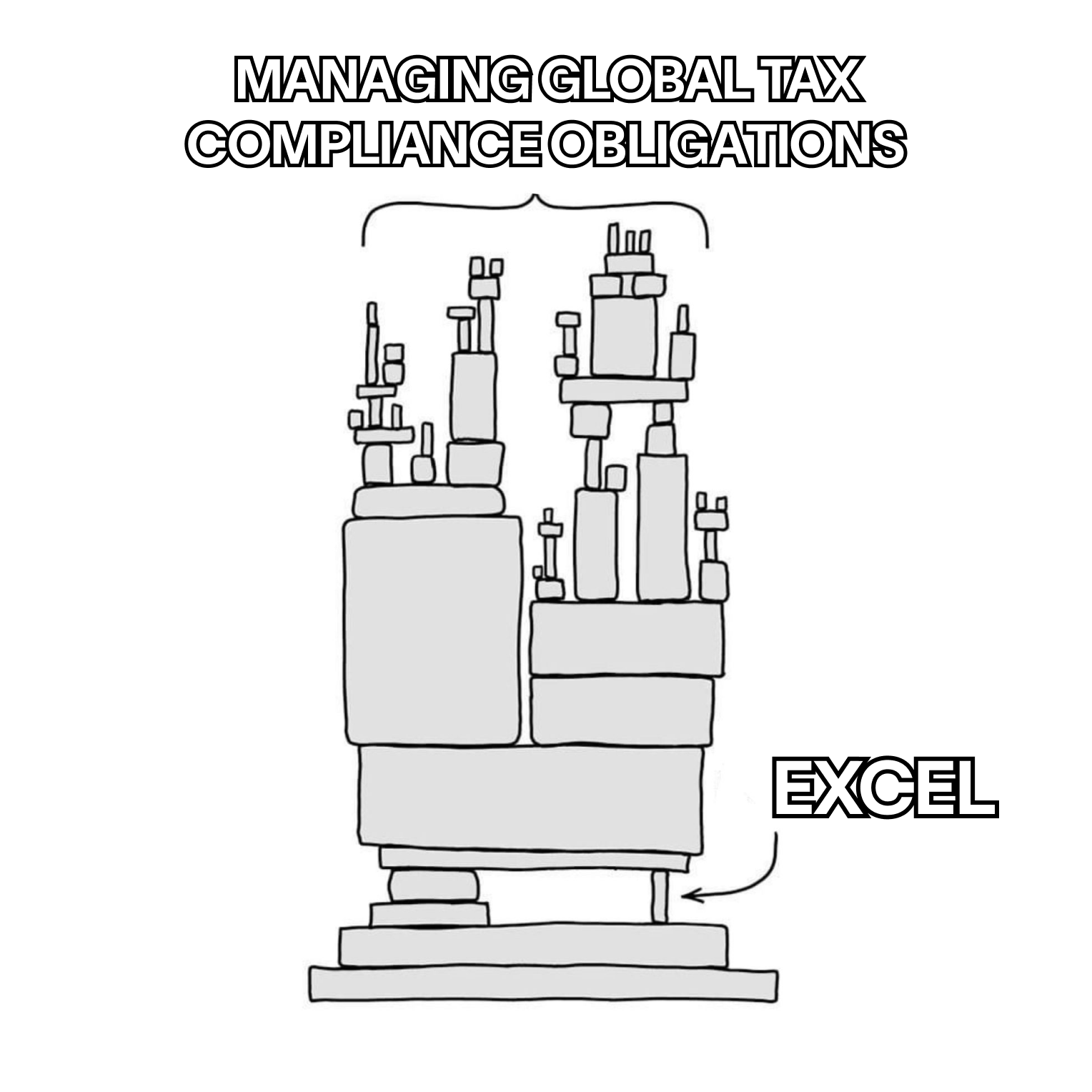
Managing global tax compliance obligations with excel
5 months agoFollowI regularly hear that in-house tax teams heavily rely on Excel for managing global tax compliance 🫣, using spreadsheets to track deadlines across various tax domains (indirect tax, direct tax, TP, WHT, local & environmental taxes, etc.), file returns, pay liabilities, and manage the necessary backplanning to meet due dates. They also use them to distribute work, track progress, maintain an audit trail, and implement basic controls. When asked if they’re satisfied with spreadsheet-based compliance monitoring, 99% say no!
Excel is a great tool with potential in the tax domain, but it’s crucial to understand its limitations. Beyond a tipping point, spreadsheets become inefficient, costly, hinder scaling, and increase risks.
Here are 10 reasons why spreadsheets in global tax compliance are suboptimal:
1. Spreadsheets don’t understand the structure and complexity of different tax domains. Sure, you can format your sheet, but maintaining and protecting it is a pain;
2. Spreadsheets can’t enforce governance and controls actively—they're passive;
3. Spreadsheets underperform in document handling, often needing a separate, unintegrated storage solution like SharePoint;
4. Spreadsheets lack robust access management, complicating collaboration with local finance and advisors;
5. Spreadsheets aren't designed for collaboration, unlike modern workflow engines, making process operationalization difficult;
6. Spreadsheets hinder scalability due to fragmented and isolated datasets, trapping data in each sheet;
7. Version control and history are burdensome, leading to confusion over the latest version or who changed what;
8. Spreadsheets are error-prone, with formatting or formulas easily broken;
9. Spreadsheets are static and dependent on the creator—inheritance of complex sheets is challenging;
10. Compliance tracking with spreadsheets offers limited oversight, transparency, and requires manual updates.